
CELEBRITY
BREAKING: Despite Russia deploying a submarine and warships to protect the oil tanker Bella 1, U.S. airborne forces began helicopter landings on the vessel minutes ago. Reports indicate U.S. forces have boarded and are attempting to seize a renamed Venezuelan oil tanker flying Russian flags, believed to be part of Russia’s so-called shadow fleet. The operation is unfolding in the North Sea, even as the tanker remains under Russian naval escort. And for Trump’s next trick? He’s about to make the left openly pro-Russia trying to explain why the U.S. shouldn’t stop a Russian shadow fleet from moving oil under fake flags…..Full details ⤵️

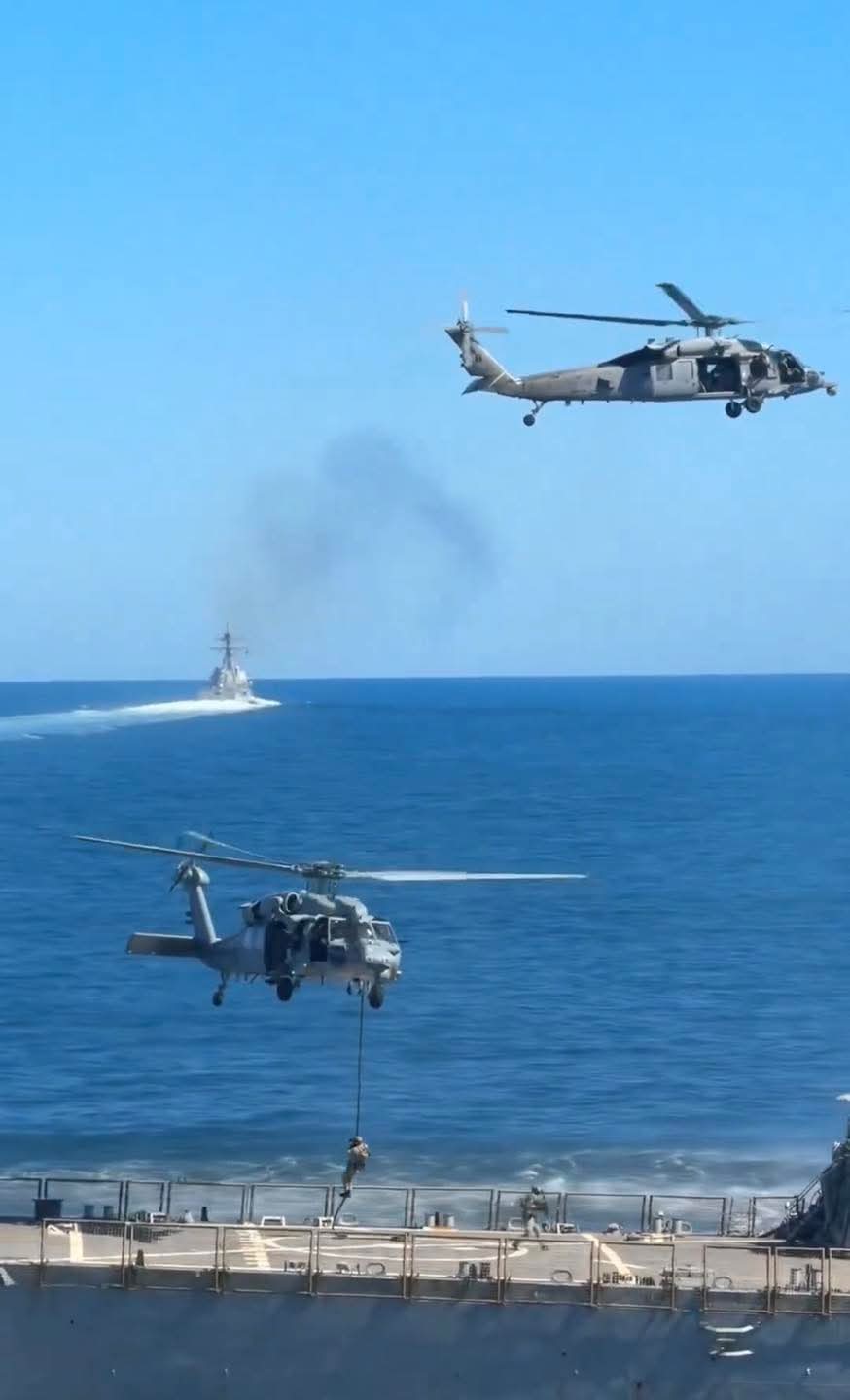
A dramatic and highly volatile confrontation is unfolding at sea tonight, as U.S. airborne forces have reportedly begun helicopter landings on an oil tanker believed to be part of Russia’s covert “shadow fleet” — despite the vessel sailing under active Russian naval protection.
According to multiple reports, American forces have boarded the tanker, a vessel formerly linked to Venezuela and now renamed and flying Russian flags, in an apparent attempt to seize control of the ship while it transited the North Sea.
What makes this moment extraordinary is not just the boarding itself — but who was standing guard.
⚓ A TANKER UNDER MILITARY SHIELD
Sources indicate Russia had deployed warships and at least one submarine to escort the tanker, a rare and provocative move that signals how sensitive this vessel is to Moscow.
The tanker is believed to be part of Russia’s so-called “shadow fleet” — a network of aging, reflagged oil tankers used to:
Move sanctioned oil
Mask true ownership
Evade Western enforcement
Operate under false or rapidly changing flags
These ships have become a central tool in keeping Russian and allied oil flowing despite international sanctions.
🚁 U.S. HELICOPTER INSERTION: A MAJOR ESCALATION
Despite the Russian escort, U.S. airborne units reportedly initiated helicopter landings directly onto the vessel, boarding it while it remained under Russian naval watch.
If confirmed, this represents:
One of the most aggressive sanctions-enforcement actions at sea in recent history
A direct test of naval deterrence between nuclear-armed powers
A signal that Washington is willing to act even when Russian forces are physically present
The situation remains fluid, and it is unclear whether Russian naval units attempted to intervene or are currently shadowing the operation.
🌍 WHY THIS MATTERS
This incident is about far more than a single tanker.
It strikes at the heart of:
Sanctions enforcement
Freedom of navigation
Maritime law
Great-power red lines
If the U.S. succeeds, it sends a warning to every operator involved in sanction-busting oil transport. If Russia responds forcefully, the risk of rapid escalation grows.
Either way, the rules of maritime confrontation may be changing in real time.
🎭 THE POLITICAL FALLOUT — AND TRUMP’S “NEXT TRICK”
The political impact may be just as explosive as the military one.
As the operation unfolds, critics are already scrambling to explain why the United States should not stop Russian shadow fleets from moving oil under fake flags — even as those fleets fund Moscow’s war machine.
And here’s the twist many observers are pointing out:
👉 Donald Trump may now force the political left into an awkward position — appearing openly pro-Russia while arguing against stopping a sanctioned shadow fleet.
Whether intentional or not, the moment highlights a growing contradiction:
Oppose Russia rhetorically
Yet resist direct action when Russia’s illicit networks are confronted
🔥 WHAT HAPPENS NEXT?
Several outcomes are possible in the coming hours:
The tanker is fully seized and diverted to a Western port
Russia lodges emergency diplomatic protests and labels the action “piracy”
Naval forces remain in close proximity, raising the risk of miscalculation
The incident becomes a precedent-setting case for future high-seas seizures
One thing is certain:
This is no longer just about oil.
It is about power, credibility, and who enforces the rules when the world’s strongest militaries collide — not on land, but on the open sea.

Trump FEARS PRISON as Court RUSHES Impeachment👈 We begin tonight with a growing political problem for Donald Trump that could seriously damage Republicans heading into the midterms. The traditional New Year’s Eve concert at the Kennedy Center has been canceled after the administration controversially renamed the venue to include Trump’s name—an action lawmakers say was illegal. Several artists have refused to perform, citing principles over profit. At the same time, Trump’s second term is increasingly defined by self-promotion and extravagance, from gilded White House renovations to massive vanity projects, even as Americans struggle with rising costs. But the real pressure is coming from Congress. Multiple articles of impeachment are now circulating, accusing Trump of obstruction of justice, abuse of power, corruption, violations of constitutional rights, and even tyranny. Lawmakers are focusing on his threats to jail political opponents, defiance of court orders, and attempts to weaponize the Justice Department. Legal experts warn that even if Trump avoids removal now, the Senate could still hold an impeachment trial after he leaves office—potentially opening the door to criminal prosecution. For Trump, this is no longer just political theater. The legal stakes are real, and rising fast👉 Do you believe Trump will actually face jail time? Sound off below!⤵️

🔴 JUST IN: Supreme Court DEVASTATES Administration as 29 Judges VOTE REMOVAL — Power Structure SHATTERED Washington is reeling after a stunning Supreme Court development in which 29 judges voted for removal, delivering a devastating blow to the administration and sending shockwaves through the federal system. According to multiple reports, the unprecedented vote triggered emergency discussions across Washington as legal experts warned the ruling represents a fundamental rupture in institutional authority. Behind closed doors, officials reportedly scrambled to assess the immediate fallout as confidence in the administration collapsed in real time. Analysts say the scale of the judicial rebuke is impossible to ignore — signaling a rare and severe loss of legitimacy that could accelerate cascading resignations and legal consequences. Comparisons to historic constitutional crises are spreading rapidly as pressure mounts from every direction. With the balance of power now in question and the next move unclear, insiders say this may be a defining moment — and the fallout is only beginning. 👉 Read the full breakdown before it disappears⤵️

BREAKING: House Democrats Have Introduced a New Impeachment Resolution Citing Article II, Section 4 of the Constitution, Alleging President Trump Has Crossed Constitutional Limits. T.R.U.M.P SHAKEN as Congress DROPS Article II, Section 4 Constitutional BOMBSHELL!!Do you believe Congress is right to act — or has the line been crossed too far?👉 Read what they’re accusing him of BEFORE this explodes⤵️

❤️ What a poignant moment: The nation was stunned as Donald Trump and his daughter, Ivanka Trump, made a heartfelt announcement that left observers emotional and the public deeply moved… Under the soft lighting of the press room, Donald’s voice so often firm and commanding wavered as he struggled to hold back emotion. Ivanka stood closely beside him, her presence steady and unwavering, a rare and intimate reflection of their deep father-daughter bond. Everyone present fell silent microphones lowered, eyes glistening realizing that this moment wasn’t about politics, power, or public image anymore it was about a father, a daughter, and a personal hardship that words alone could not fully convey. 👉 Read the full story and see why this unexpected moment has left millions deeply moved heartbreaking moment 👇

BOOM! Taylor Swift Just Set the Internet on Fire and Washington Is Shaking!didn’t hold back, calling D.o.n.a.l.d T.r.u.m.p “a self-serving showman” and issuing a stark warning to America: “Wake up before it’s too late.”With rare political bluntness, the chart-topping songwriter went straight to the point: “He’s exactly why constitutional safeguards and accountability exist.” The internet erupted within minutes. Fans are cheering, critics are stunned, and Washington is spiraling into chaos as Swift’s comments dominate headlines, social media feeds, and political roundtables.Taylor Swift made one thing crystal clear Drop your thoughts in the comments👉 Read what she said that has everyone talking⤵️

JUST IN: Mark Kelly on January 6 delivers a blistering verdict: “This was an insurrection aimed at overturning a free and fair election. It did not happen spontaneously. It happened because Donald Trump refused to accept that he lost.” Kelly didn’t stop there. He went on to unveil stunning evidence no one saw coming, triggering visible panic across Congress and sending shockwaves through Republican ranks…Do you agree with Mark Kelly’s verdict? 👉 Watch What Happened Next⤵️

SENATE EXPLODES! Dozens of Lawmakers TURN on Trump and HALT Venezuela War Plan — Watch the Jaw-Dropping Fallout Before It’s Buried! 🔥👇

BREAKING: Minneapolis Police Chief Brian O’Hara has directly contradicted President Donald Trump, stating that Renee Nicole Good was the only person injured during today’s incident. This comes after Trump publicly claimed that an ICE officer was injured and recovering in the hospital— The contradiction has reignited accusations that Trump is once again attempting to control the narrative before the full truth emerges. Critics argue this pattern is familiar: push a version of events early, repeat it loudly, and let misinformation spread before evidence can catch up. O’Hara went further, revealing disturbing details that many say echo the same playbook used around January 6—a moment that exposed how dangerous false narratives can be. According to observers, Trump and his allies are now scrambling as more information surfaces.👉 See what Trump claimed vs. what the facts reveal

JUST IN: Taylor Swift Submits Formal Petition to Congress Calling for the Dissolution of ICE, Citing the Fatal Shooting of Minneapolis Resident Renee Nicole Good and Arguing the Agency Has “Done More Harm Than Good” to American Communities 👉 See what sparked the national firestorm ⚠️ What really happened — read before you judge Full details ⤵️

THE FINAL SUNSET 💔 — Connor McDavid Canceled EVERYTHING Just to Hold His Mother’s Hand One Last Time… She Passed Away in His Arms 👉 Read the heartbreaking moment that left fans in tears😭⤵️

🚨 1 MIN AGO: CANADA’S ARCTIC MOVE LOCKS THE U.S. OUT OF A $900 BILLION CORRIDOR — TRUMP SHOCKED Canada has just made a sudden Arctic power move that is sending shockwaves through Washington, effectively cutting the United States out of a $900B strategic corridor overnight. Sources say the decision caught U.S. officials completely off guard, triggering urgent briefings as analysts warn the balance of power in the Arctic has just shifted. With trade routes, military positioning, and global supply chains now at stake, insiders claim Trump was stunned by how fast Canada moved — and how little leverage the U.S. had to stop it. 👇 What this Arctic decision unlocks for Canada — and what it costs America — is far bigger than anyone expected. See what Canada just secured… and why America couldn’t stop it,👇 Do you think Canada made the right move — or should the U.S. push back harder? 💬 Drop your thoughts below
